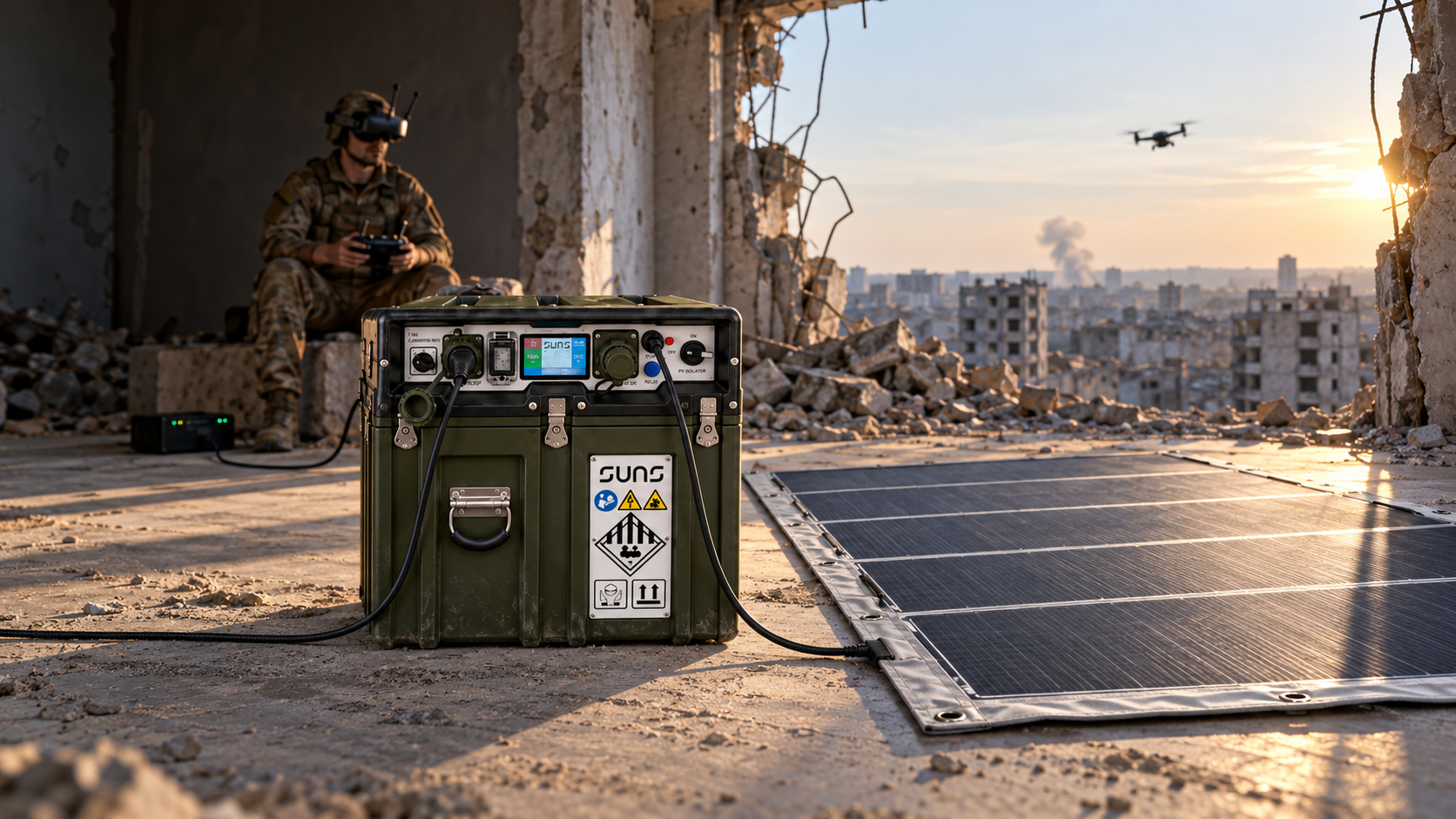
Every drone mission ends with the same question: where do the next batteries get charged? A drone team’s output is limited by its batteries, and its batteries are limited by whatever power is available at the position. Off-grid drone charging is therefore a core part of the operation, not a side task.
Why drone teams have a power problem
The US Army’s 2026 lessons-learned report on tactical energy in Ukraine puts numbers on it. A small quadcopter battery gives roughly 25–35 minutes of flight and takes 60–90 minutes to recharge, so teams rotate packs constantly. One drone team can go through 10–12 battery charges a day, which adds up to about 2–3 kWh. The Army’s 2025 report on battlefield energy sums up the stakes in one line: “A drone launch team without recharge capability becomes irrelevant after its first sortie.”
The usual answer has a cost
Most teams solve this with small petrol generators. According to the same report, a frontline drone team running two of them can burn 20–30 liters of fuel a day. Generators also create noise and a thermal signature that enemy drones can detect. Every liter has to be brought forward, and every running generator gives the position away to the same kind of aircraft the team is flying.
Charge from a silent buffer
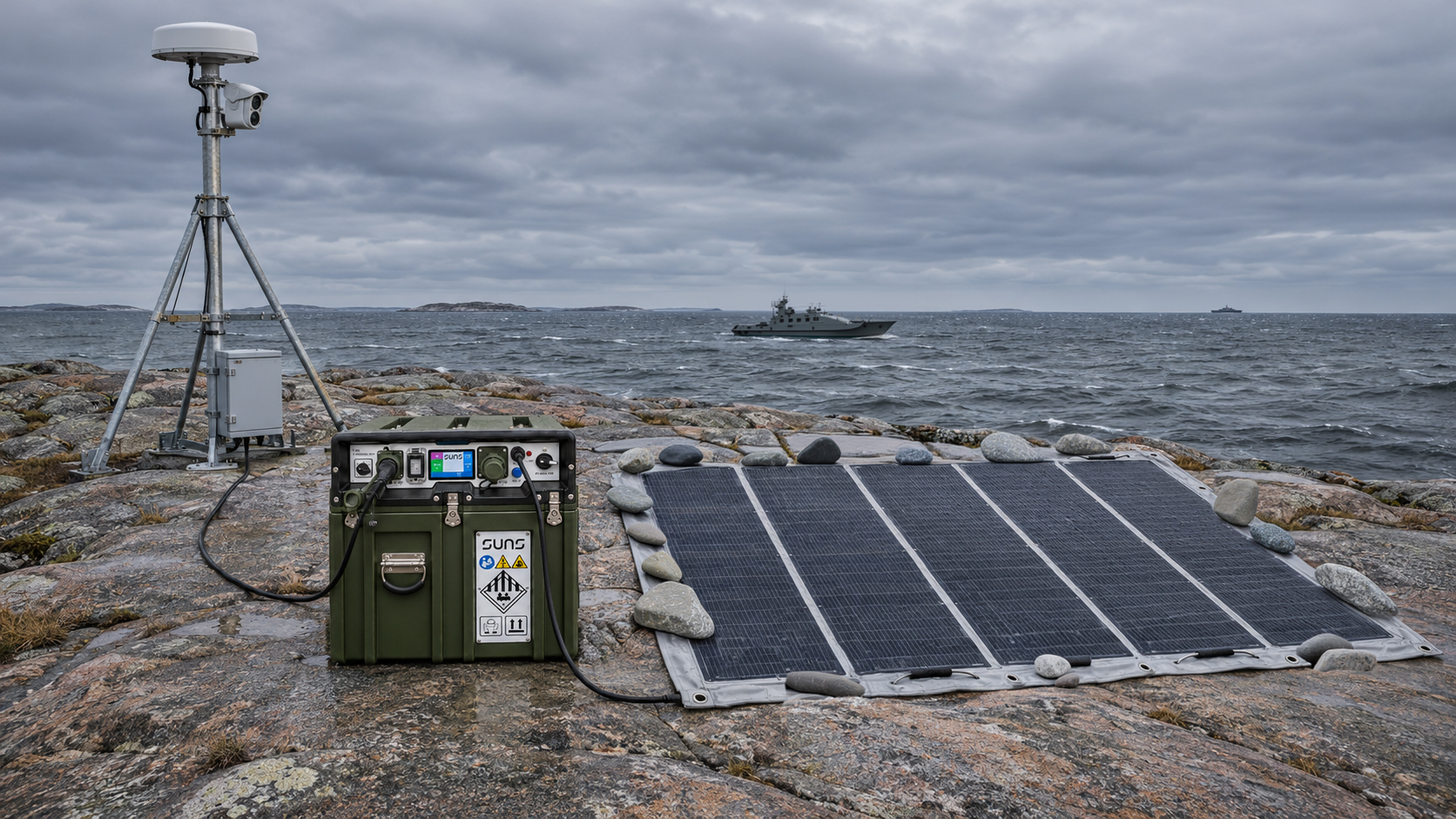
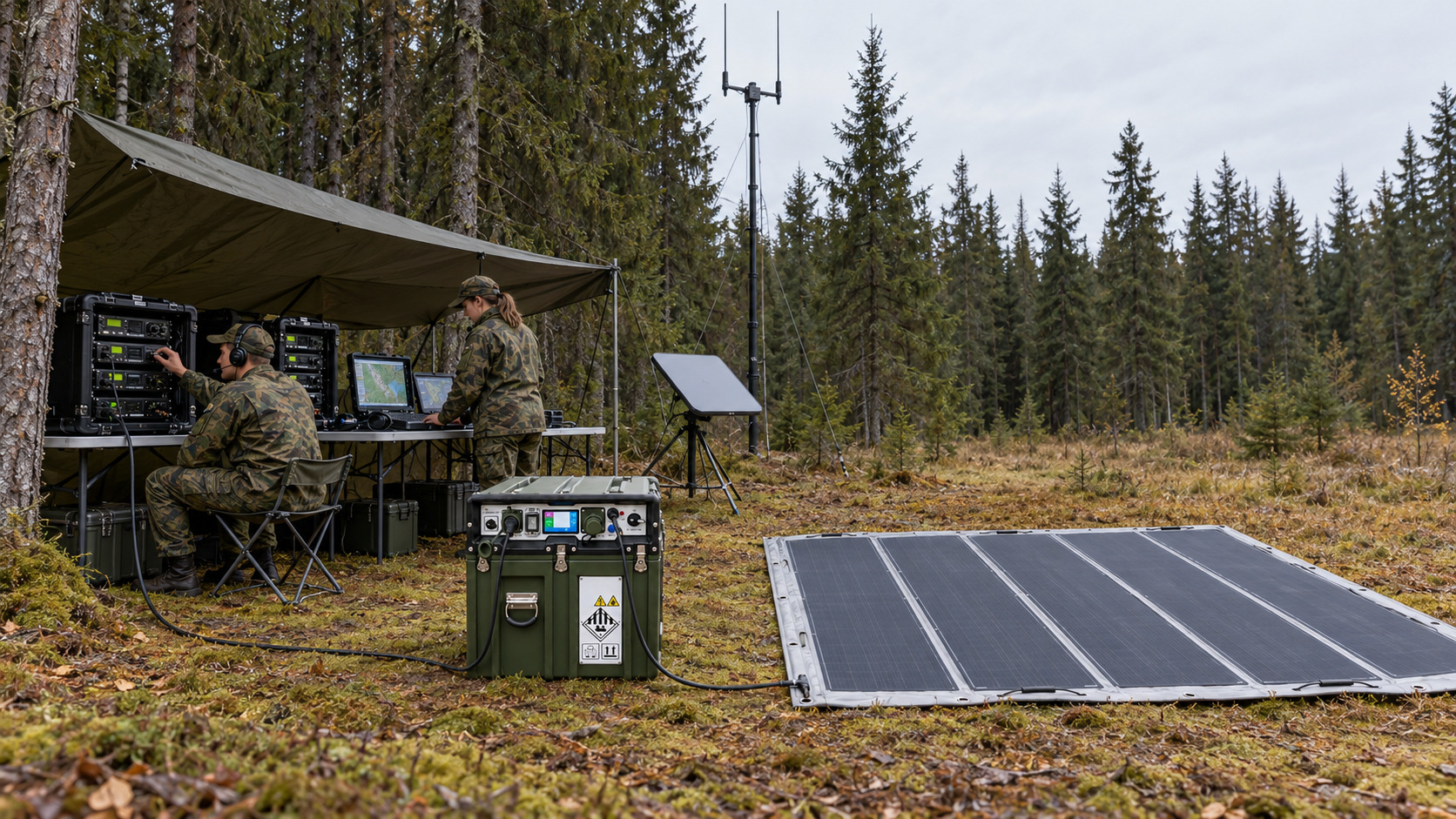
The SUNS Energy Hub stores 5 kWh and delivers 3,700 W continuously from a 230 V, 50 Hz output. On paper, that is enough for roughly 20 to 80 drone battery recharges from a single charge, depending on pack size (small quadcopter packs hold 60–240 Wh). At the Army’s figure of 2–3 kWh a day for a drone team, one charge covers close to two days of charging. The same unit can also run a laptop, a SATCOM terminal and lighting while the chargers work.
The Army’s own examples keep sensitive equipment on a battery buffer instead of connecting it directly to a generator, to avoid brownouts and radio noise. The Energy Hub has a built-in UPS function for exactly this, so power to the chargers and the command equipment stays steady. And since the batteries do the work, a generator, if one is used at all, only has to run in short scheduled windows. The charging current is adjustable from 4 to 16 A, so the Energy Hub can be matched to the generator or mains connection available.
Solar that moves with the team
Fast Fold is a flexible solar mat rated at 1,000 Wp. It weighs 28 kg, is portable by a single person, unfolds in under two minutes and carries an IP67 rating, so rain does not stop it. Its rated voltage of 127 V sits inside the Energy Hub’s 65–250 V solar input range, so the mat connects straight to the unit.
For comparison, the Army report describes a foldable 100 W panel producing 300–500 Wh a day in Ukrainian winter conditions. Fast Fold has ten times that rated output, which scales to roughly 3–5 kWh a day, about the same as a drone team’s daily charging need. This is a scaled estimate, and real output depends on location, season and shading. Nothing has to be refueled, and the heated batteries are rated for full power from −20 °C to +40 °C.
Built to be moved
Drone teams relocate often. The Army report describes units moving generators every day and using quick-disconnect systems so that power setups can be taken down in minutes. The Energy Hub is ready in less than a minute, and Fast Fold in less than two. There is nothing to fuel or warm up, and the system is plug-and-play. The Energy Hub weighs 72–97 kg depending on configuration, and it can travel on a vehicle or on a tracked platform such as PTI Robotics’ Provider, which we introduced in our latest news article.
Several small units are also safer than one large one. The Army describes dispersing multiple small power sources so that losing one does not stop operations. A team can place an Energy Hub with each drone cell instead of depending on a single large source, so one loss costs a fraction of the capacity.
Energy independence beyond defence
The same logic applies wherever drones work far from a socket. Search and rescue teams, infrastructure inspection crews, mapping and survey operators and disaster-response units all depend on batteries and all work in places where power is unreliable or missing. A portable system that charges from the sun means the mission is not limited by what is left in the last battery.
For heavier loads, such as pumps, tools and larger field systems, take a look at our new 3-phase Energy Hub with 15 kWh of storage and 11 kW of output.
Contact us
If you are planning power for a drone operation, we can walk through configurations and sizing with you.
Contact us at info@sunsenergy.com.
Sources
SUNS Energy Hub and Fast Fold datasheets, October 2026.
US Army Center for Army Lessons Learned, Powering the Front: Tactical Energy Delivery and Management in the Ukraine War, No. 26-1116, March 2026. PDF
US Army Center for Army Lessons Learned, Best Practices on Operationalizing Battlefield Energy, No. 25-1085, August 2025. PDF