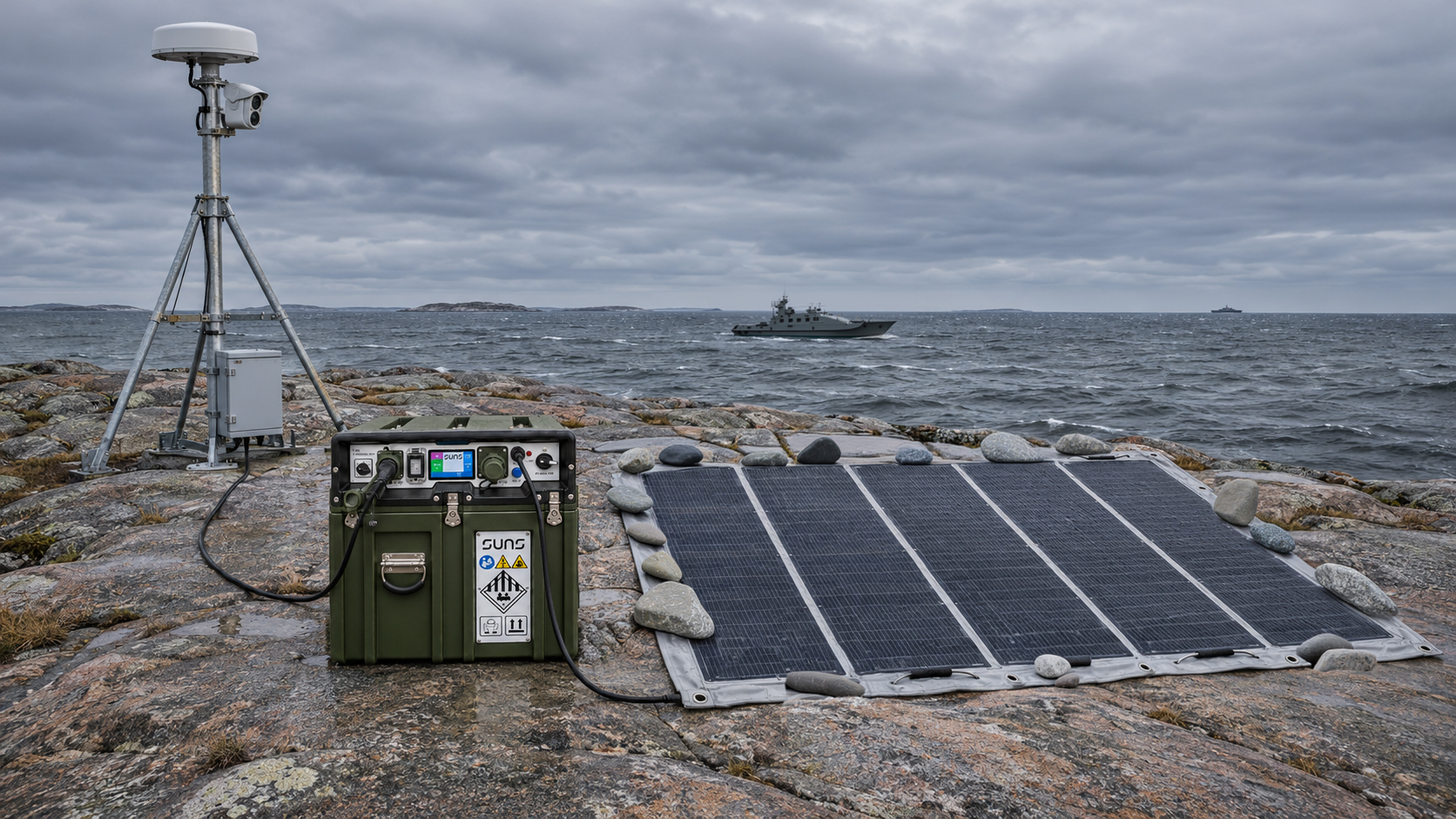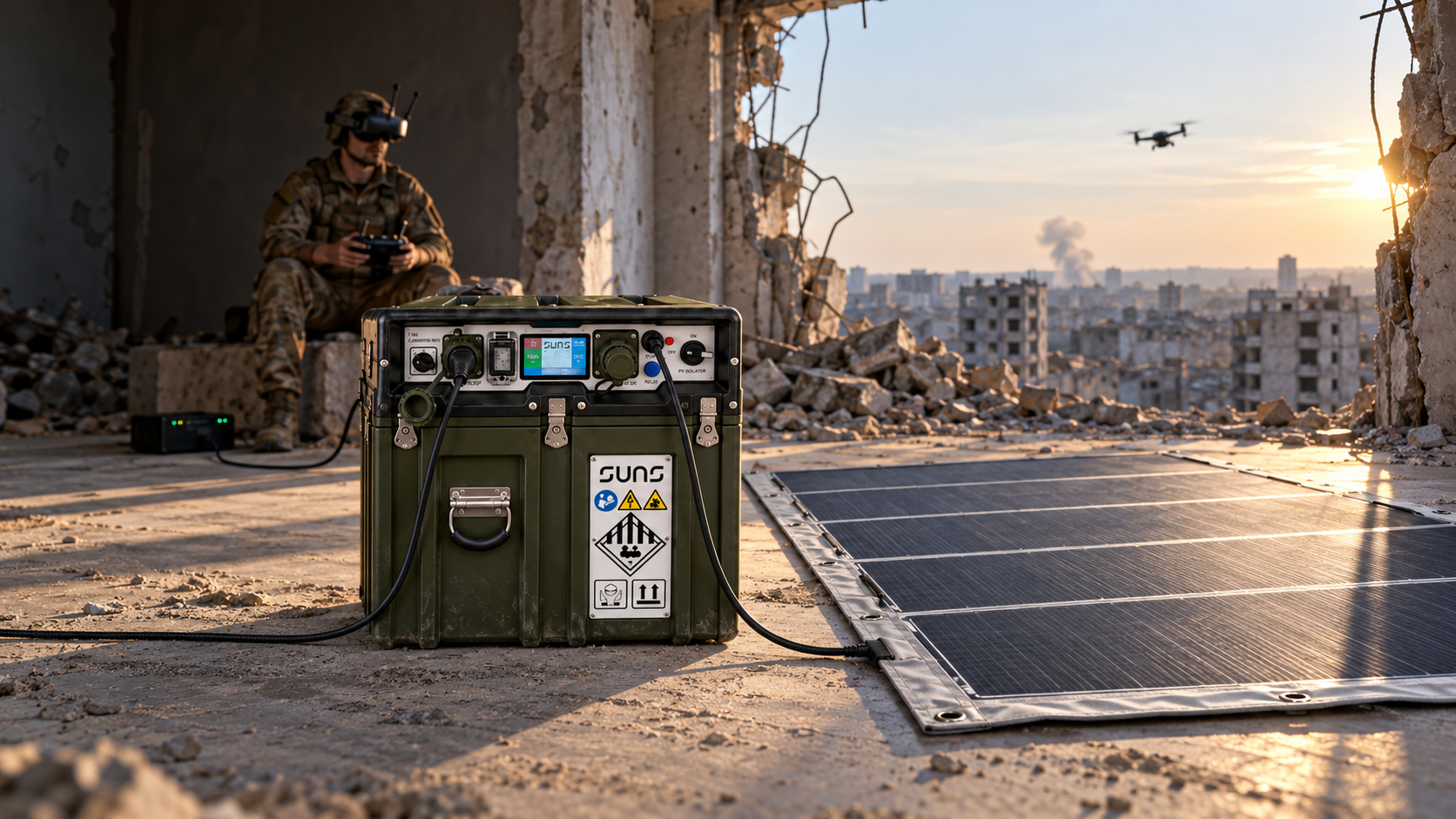
A command post is only as good as its connection. When the radios go quiet or the satellite link drops, orders stop moving and the picture of the situation goes stale. The US Army’s 2025 report on battlefield energy puts it in one sentence: “A command post that goes dark loses tempo.” Power is what keeps it lit.
What a communications post actually draws
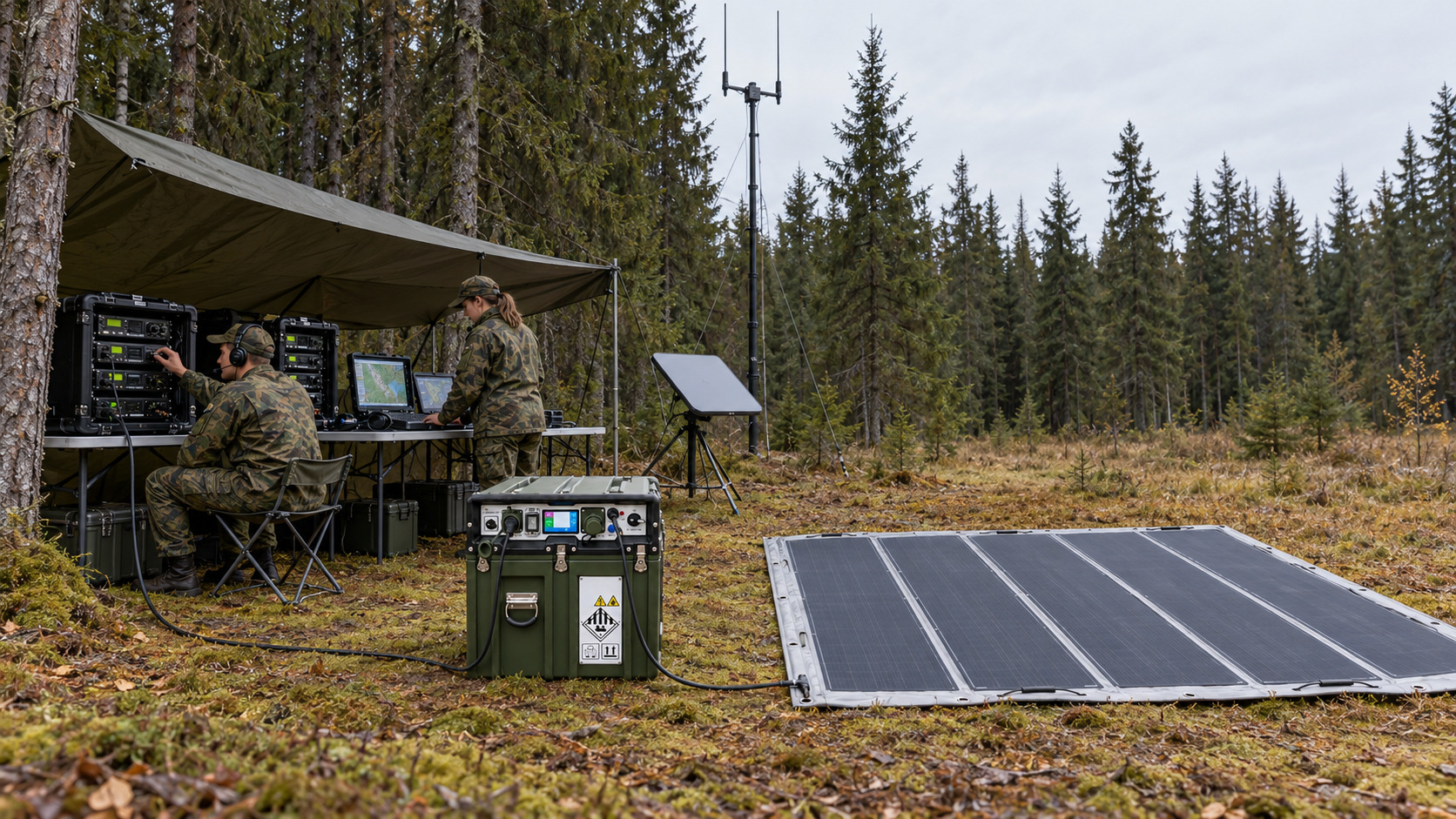
The US Army’s 2026 lessons-learned report on tactical energy in Ukraine lists the loads. A company command post runs 10–15 radios, several laptops and secure data links, and draws 2–3 kW continuously. A single tactical radio uses about 35 W, a satellite terminal such as Starlink 100–150 W, and a mission-planning laptop 30–60 W. A small communications node like the one in the picture, with a satellite terminal, two laptops and four radios, adds up to roughly 300–400 W. The numbers are modest, but they run around the clock and nothing on the list can be switched off.
Why a generator alone is a poor fit
A generator that runs all day for a few hundred watts is the wrong tool. The same report warns that running tactical generators below about 30 percent of their rated output can cause wet stacking, which damages the equipment. It also lists acoustic and infrared detection of the generator as a risk, and recommends buffering with batteries and running the generator only in pre-planned windows.
Power quality matters too. The Army’s own communications examples keep satellite terminals on a battery buffer instead of connecting them directly to a generator, to avoid brownouts and radio frequency noise. A communications post depends on a clean, stable supply.
A battery buffer in front of the equipment
The SUNS Energy Hub stores 5 kWh and delivers 3,700 W continuously from a 230 V, 50 Hz output. It has a built-in UPS function, so the radios, laptops and satellite link keep running if the input changes or drops out. At 300–400 W, one full charge covers roughly 12–16 hours of operation on paper. The Army’s scheduled communication windows, where the terminal sleeps between sync times, stretch that further.
The charging current is adjustable from 4 to 16 A, so the Energy Hub can be matched to a small generator or a weak mains connection, and PowerControl and PowerAssist boost the capacity of that connection when the load rises. A generator, if one is used, then runs in short, planned windows at a good load and shuts off. The rest of the time the post is silent. The unit can be configured, monitored and controlled on site, and all of its radios can be switched off, which suits a post that manages its own emissions.
Solar that goes with the post
Fast Fold is a flexible solar mat rated at 1,000 Wp. It weighs 28 kg, is portable by a single person, unfolds in under a minute and carries an IP67 rating, so rain does not stop it. Up to four Fast Fold 1,000 Wp can be connected to Suns portable Energy Hub.
For comparison, based on the Army report, a 1,000 Wp panel could produce an estimated 3–5 kWh a day in Ukrainian winter conditions. Just one Fast Fold has the rated output for a drone team’s daily charging need. This is a scaled estimate, and real output depends on location, season and shading.
In a northern forest, light is limited in autumn and winter, and tree cover shades the ground. The practical setup is the one in the picture: the mat in a clearing, the Energy Hub and the equipment under cover. Solar covers part of the load, and the generator covers the rest.
Built for cold and for moving
The Energy Hub uses LiFePO4 batteries with a self-heating function and is rated for full-power operation from −20 °C to +40 °C. The Army report names cold as a factor that impairs both generators and battery performance. Heated batteries keep that from becoming a manual task.
Command posts also move. The Army describes quick-disconnect setups that can be taken down in minutes, and dispersal so that one loss does not stop operations. The Energy Hub is ready in under a minute and weighs 72–97 kg depending on configuration.
Beyond defence
The same setup suits any team that depends on communications far from the grid: emergency services, disaster-response coordination, search and rescue, and remote field research. Wherever a radio or a satellite link must stay up, a quiet battery buffer with solar does the job.
For heavier loads, see our new 3-phase Energy Hub with 15 kWh of storage and 11 kW of output. For drone teams, read how a portable Energy Hub keeps batteries charging in the field.
Talk to us about your requirement
If you are planning power for a command post or a communications node, we can walk through sizing and configurations with you.
Contact us at info@sunsenergy.com.
Sources
- US Army Center for Army Lessons Learned, Powering the Front: Tactical Energy Delivery and Management in the Ukraine War, No. 26-1116, March 2026. PDF
- US Army Center for Army Lessons Learned, Best Practices on Operationalizing Battlefield Energy, No. 25-1085, August 2025. PDF
- SUNS Energy Hub and Fast Fold datasheets, October 2026.