What’s new
- 15 kWh battery capacity
- 11 kW three-phase output
- Heated batteries for reliable operation in cold conditions
- Automatic generator control, which brings fuel savings and extends generator service life
- Replaceable battery packs that can be charged elsewhere when needed
Why three-phase matters
Single-phase power covers radios, laptops and drone chargers. Heavier equipment, such as workshop tools, pumps, compressors and larger field systems, is built for three-phase supply. Until now, feeding those loads has usually meant running a generator around the clock.
The US Army’s 2026 lessons-learned report on tactical energy in Ukraine shows how wide the range of loads is. A company command post draws 2–3 kW continuously, a casualty stabilization point 3–5 kW, and a vehicle-mounted EW jammer 5–10 kW. An 11 kW output has room for each of these.
Let the generator run only when it should
Generators are least efficient at light load. The same report warns that running tactical generators below about 30 percent of their rated output can cause wet stacking, a condition that damages the equipment. This is a common situation in the field: a large generator feeding a small, steady load.
With the Energy Hub, the batteries carry the light load. The automatic generator control starts the generator when charge is needed and stops it when it is not. The generator then runs at a load where it is efficient and shuts off, which means less fuel burned, fewer running hours and a longer service life. It also means less noise and heat, because a generator that is off cannot be heard or seen by a thermal sensor. The Army’s own field experiments reached the same conclusion: scheduling generator runs and operating closer to optimal load reduced fuel use and thermal and acoustic exposure.
Built for cold
Cold, snow and mud are named in the same report as factors that impair both generators and battery performance. Units insulate or rotate batteries to keep them in an operating range. The Energy Hub’s batteries are heated, so cold conditions are built into the design instead of being managed by hand.
Batteries that move separately from the system
The battery packs are easy to replace and can be charged somewhere else if necessary. This fits how the Army describes managing field energy: depleted batteries are recovered, recharged and put back into circulation, like any other supply. A charged pack can go out while a depleted one comes back, without moving the whole system.
Power that moves with the platform
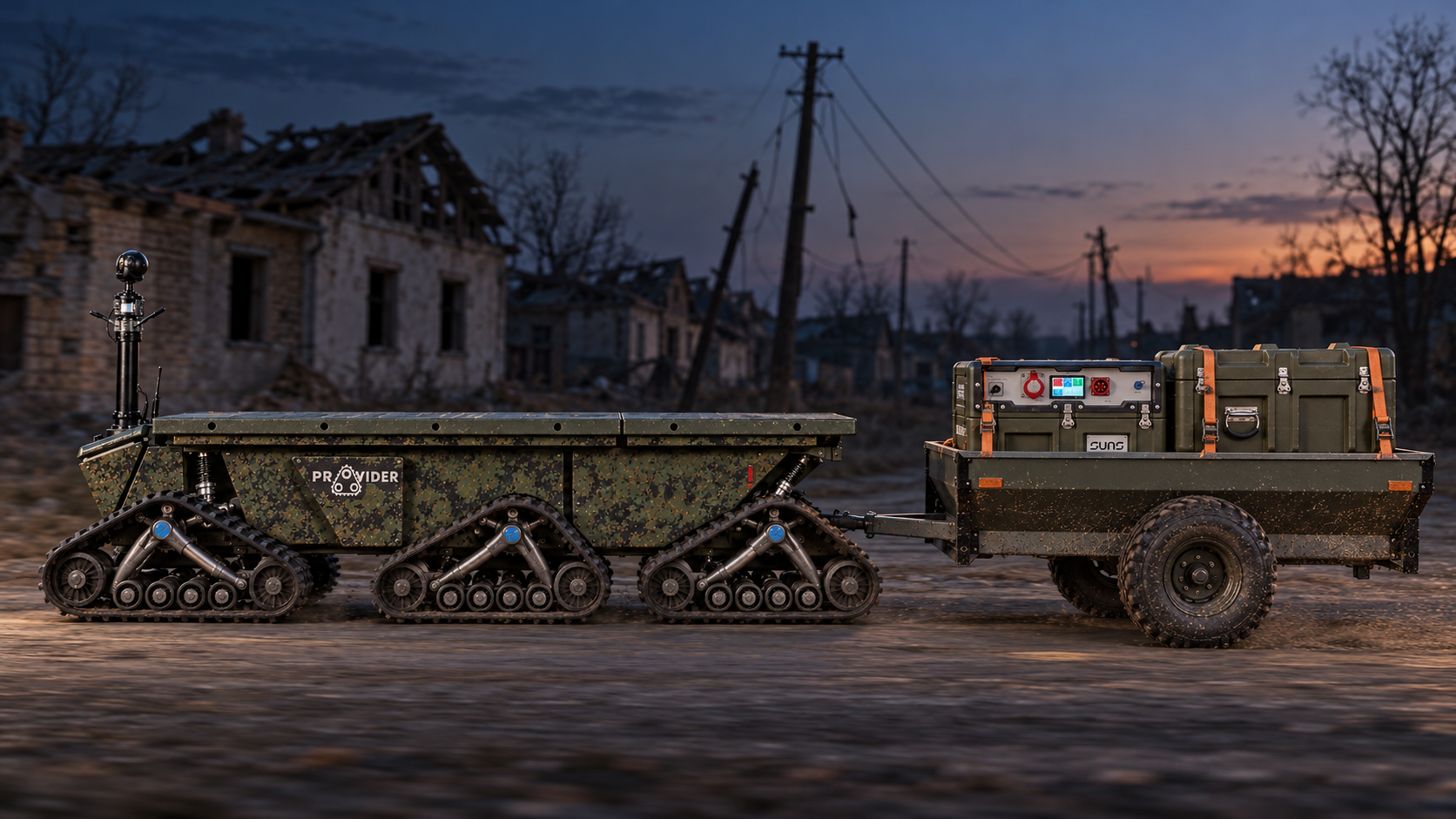
SUNS has worked together with PTI Robotics to pair the new Energy Hub with Provider, a tracked platform that carries the system to where the power is needed. A heavy battery system no longer has to be carried by hand or by a truck all the way to the position. The image in this article is an illustration of what this combination could look like in the field.
This follows what the US Army’s lessons-learned reports describe: energy assets must be portable and deployable under fire, and dispersed, mobile energy nodes can be relocated quickly, which reduces the risk of losing everything to one strike. The Army’s 2025 report goes further and calls for a logistics network that can push and pull modular power across every echelon. A robotic platform carrying a modular battery system is one way to do that.
Where it fits
- Defence: command posts, aid stations and sensor positions. For aid stations, the Army’s reference package is 10–15 kWh of storage behind a 5–7 kW generator, and the new Energy Hub sits at the top of that storage range.
- Robotic and unmanned platforms: mobile power for sensor positions, charging stations and field equipment that people do not need to reach.
- Disaster relief and infrastructure backup: three-phase supply for heavy equipment where the grid is down.
- Construction, mining and events: quiet, low-emission three-phase power that runs on a generator only part of the time.
Talk to us about your requirement
If you are planning a three-phase power requirement, we can walk through specifications and configurations with you.
Contact us at info@sunsenergy.com.
Sources
US Army Center for Army Lessons Learned, Best Practices on Operationalizing Battlefield Energy, No. 25-1085, August 2025. PDF
US Army Center for Army Lessons Learned, Powering the Front: Tactical Energy Delivery and Management in the Ukraine War, No. 26-1116, March 2026. PDF