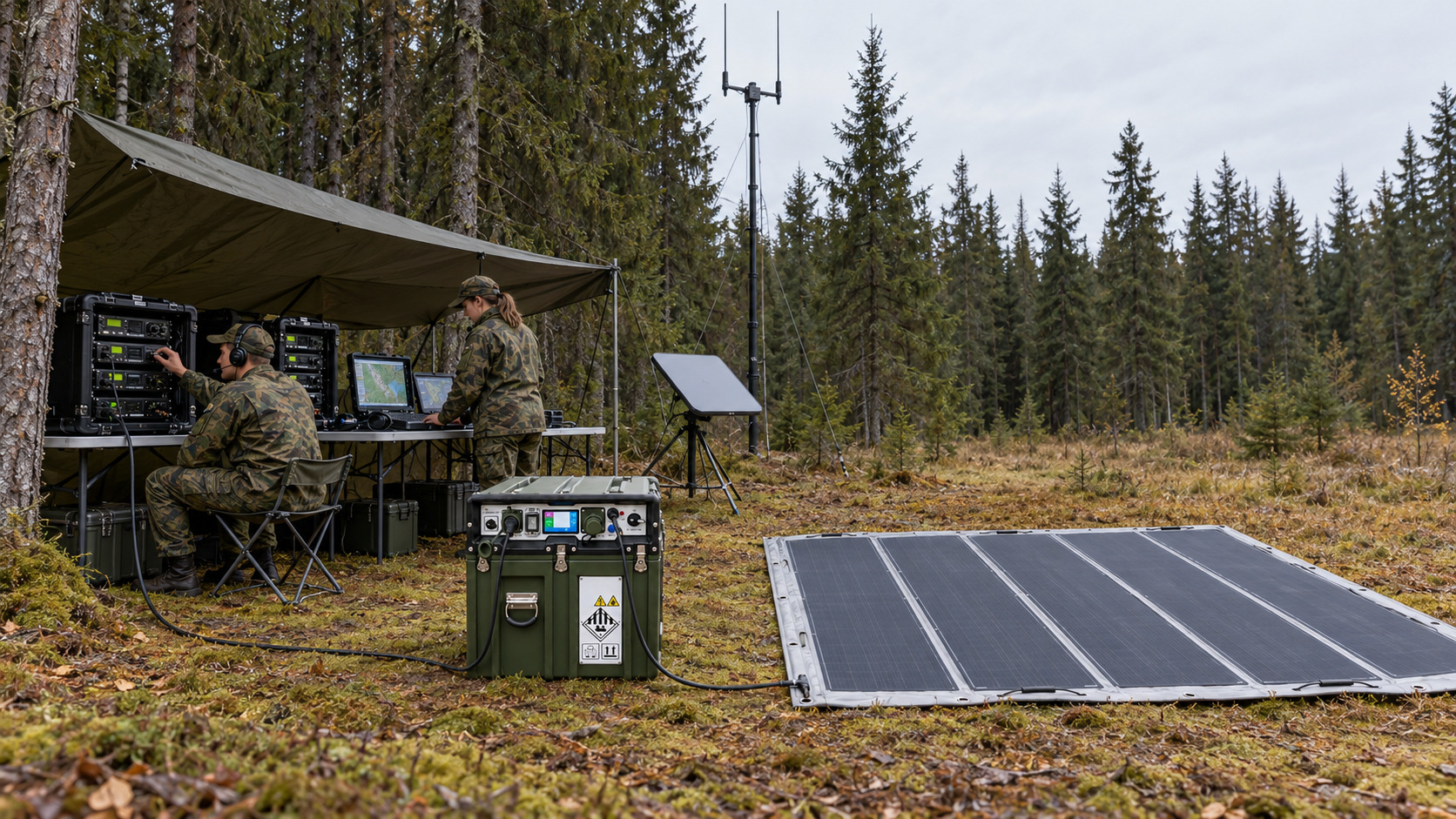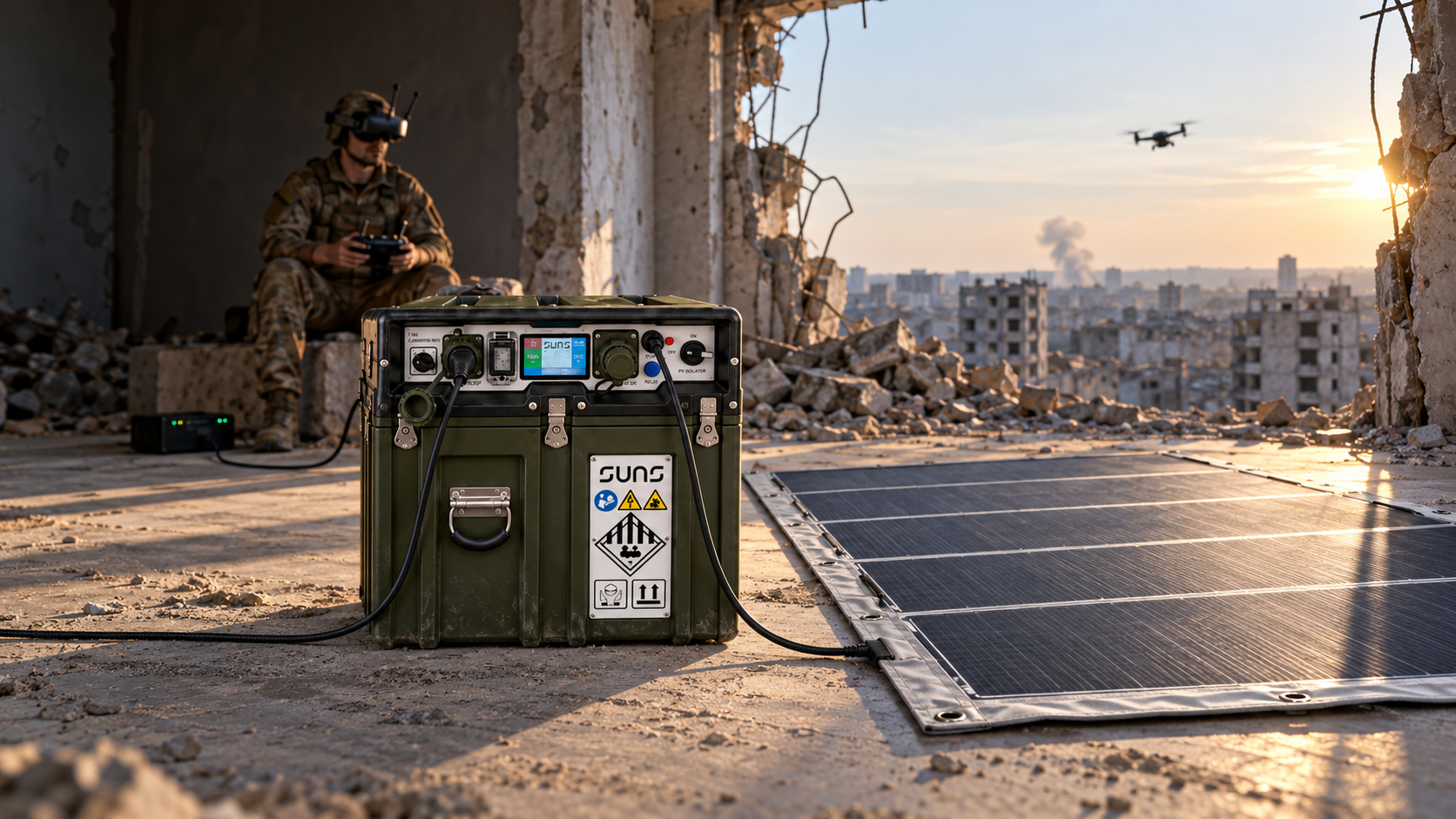
Detection is a chain: sensor, link, power. The first two get most of the attention. The US Army’s 2025 report on battlefield energy describes the third in one line: “A sensor network that loses power becomes a dead node.” A remote station that goes dark stays dark until someone can make the trip to bring it back.
Small loads, long time
The load of a sensor station is usually modest. The US Army’s 2026 lessons-learned report on tactical energy in Ukraine looks at two acoustic detection networks. Zvook has thousands of nodes spread across roughly 20,000 km², and each node draws only a few watts. The report says nodes run 24–72 hours on a modest lithium pack or portable power station, and are rotated between two or three packs. Some sites add a 100 W solar panel to trickle charge, which adds 12–24 hours. The Sky Fortress network has about 9,500–10,000 sensors, and the report notes that endurance on batteries is often under 24 hours of continuous operation.
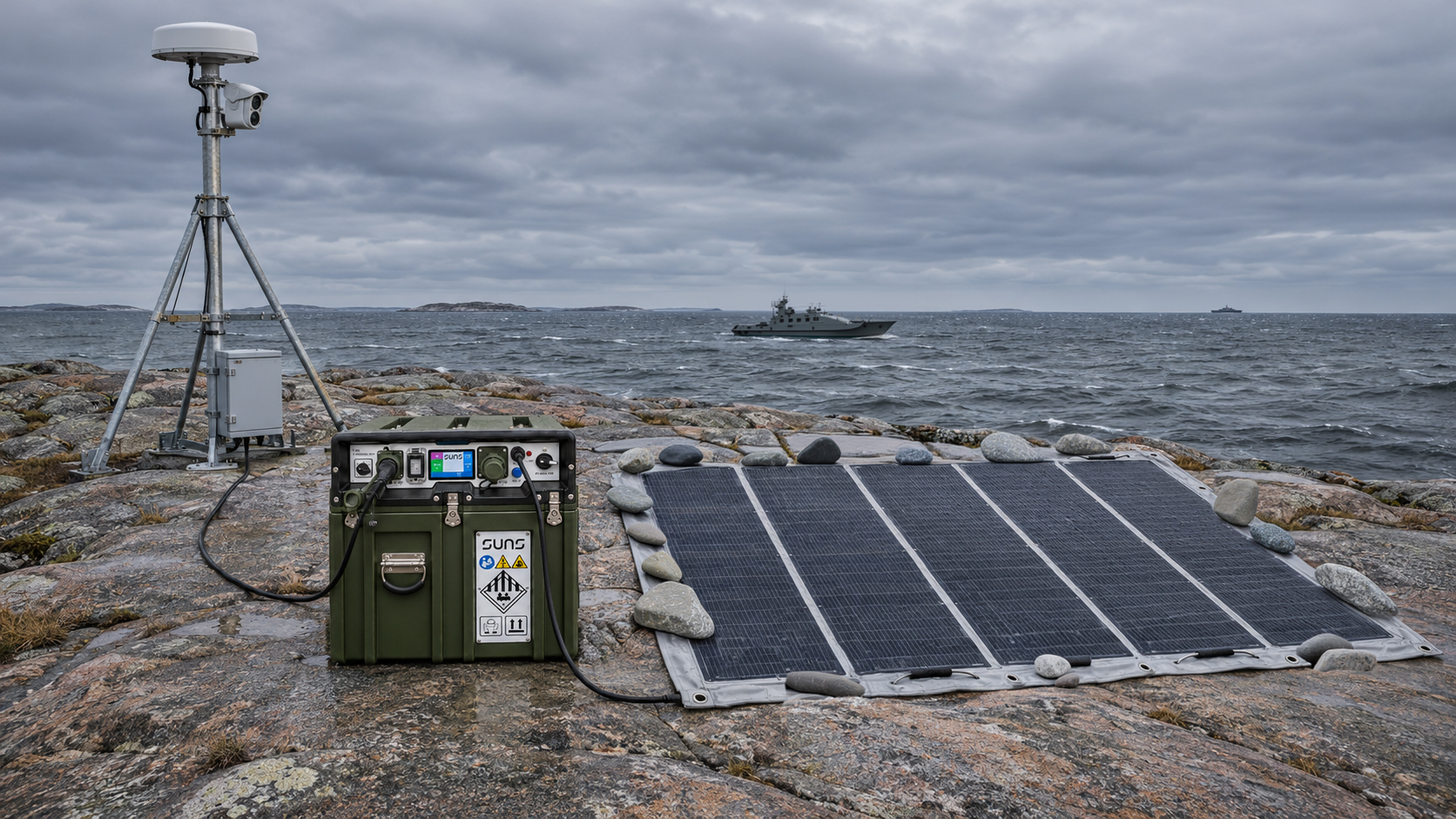
For these stations, endurance is mostly a question of stored energy. A 5 kWh Energy Hub is a different scale from a pocket battery pack. For a small load such as a sensor node, a camera and a radio link, one charge gives several days of operation, and with a Fast Fold mat in the sun, a station like this can run practically indefinitely in many locations.
Clean power matters as much as enough power
The same report makes a point that is easy to miss. Unstable voltage, or raw generator output fed directly to a node, can cause the node’s AI to produce false alarms or misclassify what it hears. In the Zvook network the nodes run on clean power from a power station, and the generators only recharge the power station instead of feeding the node. The report gives a false-positive rate as low as 1.6 percent.
That matters more as cameras and sensors do their analysis at the edge. The SUNS Energy Hub delivers 3,700 W from a 230 V, 50 Hz output and has a built-in UPS function. A generator, if one is used, only has to charge the battery. The charging current is adjustable from 4 to 16 A, so the Energy Hub can be matched to the generator or mains connection available.
Solar that goes with the station
Fast Fold is a flexible solar mat rated at 1,000 Wp. It weighs 28 kg, is portable by a single person, unfolds in under two minutes and carries an IP67 rating.
The Army report describes a foldable 100 W panel producing 300–500 Wh a day even in Ukrainian winter conditions. Fast Fold has ten times that rated power, which is a comfortable margin for a low-power station. In many locations a single mat keeps the battery topped up and the station running. Where the light is weaker or the load is heavier, the battery carries the station through, and a generator or mains connection can top it up in short, planned windows. We size the combination to the site.
Fewer visits
A station on a skerry or a ridge is expensive to visit, and every visit is a trip by boat, helicopter or off-road vehicle. The Army’s experiments with energy storage modules in 2024 reported teams operating 56 to 96 hours on a single storage module without relying on generators or vehicles, with low thermal and acoustic signatures and no unnecessary movement for fuel.
Battery and solar power bring the same benefit to a fixed station: fewer trips for fuel, and no generator noise or heat for most of the time. Where a generator is part of the setup, the battery lets it run in short, planned windows at a good load instead of all the time. The Army report describes the same hybrid approach, running generators on a schedule and switching to batteries or solar at other times.
The report also describes dispersing small power sources so that losing one does not stop operations. A network of stations can have an Energy Hub at each, so one loss costs one station and not the network.
Cold, wet and exposed
The Energy Hub’s LiFePO4 batteries are heated, and it is rated for full power from −20 °C to +40 °C. The Energy Hub has an IP54 rating, which protects against dust and splashing water, and Fast Fold is rated IP67. For stations fully exposed to sea spray or heavy weather, we recommend a suitable enclosure and can go through the options with you.
Beyond defence
The same setup suits any unattended station far from the grid: coastal and port monitoring, border and sea-area awareness, critical infrastructure, weather and environmental stations, and wildlife and research cameras. Wherever a sensor must keep watching between visits, a quiet battery buffer with solar, and a generator as backup where needed, is a practical way to keep it powered.
For a station with a drone, see how an autonomous drone charging station was tested with DR1 and Xamk. For communications posts, read how a portable Energy Hub powers field communications.
Talk to us about your requirement
If you are planning power for a remote camera or sensor station, we can walk through sizing and configurations with you.
Contact us at info@sunsenergy.com.
Sources
- US Army Center for Army Lessons Learned, Powering the Front: Tactical Energy Delivery and Management in the Ukraine War, No. 26-1116, March 2026. PDF
- US Army Center for Army Lessons Learned, Best Practices on Operationalizing Battlefield Energy, No. 25-1085, August 2025. PDF
- SUNS Energy Hub and Fast Fold datasheets, October 2026.